
A man with no home becomes the boss of a place that belongs to everyone. A kid from the projects who owned six guns at thirteen now represents his country. A college student crosses the city to play a game... and finds a family. All of it happens around two concrete tables in Bryant Park.
The tables don't ask for a résumé.
They don't check your credit score, your criminal record, or your zip code. They just sit there... metal nets, wind, dirt, and all... waiting for whoever shows up.
That's the quietly radical thing about Bryant Park's outdoor ping pong tables. They're free. Open. No barrier to entry. And because of that, they've become one of the most honest community building experiments in New York City.
A Park Reborn
Twenty years ago, this patch of green was a no-go zone. Drug deals. Danger. The kind of place you walked around, not through.

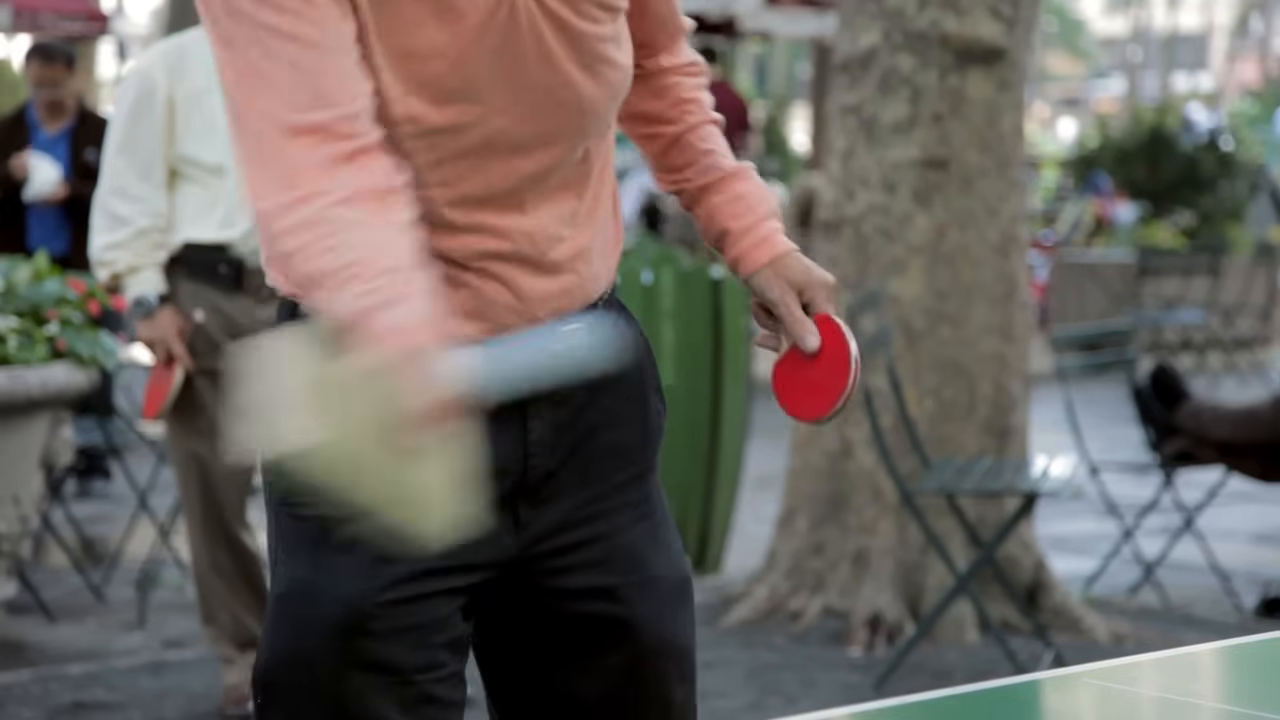
Now? Corporate workers in button-downs rally against bike messengers. A 70-year-old named Sergio smashes high balls like he's got something to prove. A man named Crazy Tyrone shows up with a literal block of wood for a paddle and still gives people fits.
The transformation didn't come from a committee or a grant proposal. It came from something simpler. Public space design that trusted people with access... and let them build the rest.
The Rock of the Park
Gregory is almost 60. He's been homeless twice. He's been through the prison system three times. Crack cocaine nearly consumed him.
He doesn't hide any of it.
"I tell somebody, it's consequences of my own actions," he says. No spin. No pity play. Just honest reckoning from a man who climbed out of the pit and refuses to pretend the pit doesn't exist.
Here's what gets me... the other players call him the boss of the tables. Not because he runs things with authority. Because he runs things with presence. He's always there. Consistent. Reliable. The rock.
Broken as superpower. Right there in Bryant Park.
Gregory holds onto a principle from 12-step programs: "If you change your thinking, you will change your behavior." Simple. Not easy. But simple. He changed his thinking. Then his behavior followed. And the tables gave him a place to practice being the man he was supposed to be.
By the film's end... he's got a job. Maintenance. Wednesday through Sunday. He misses the tournaments now, but he's paying rent. He's got his dignity back.
The $20 Hustle That Saved a Life
Wally Green grew up in Marlboro Projects in Brooklyn. At 13, he owned six guns.
Let that land.
Six.
His trajectory was written in statistics most people don't survive. Every friend from that era? Dead or in jail. Every single one.
But someone offered him $20 to be a practice partner at a table tennis club. A hustle. That's all it was. Twenty bucks to hit a little white ball back and forth.
Six months later, that man sent him to Germany. Flight paid. He trained with elite young athletes. He learned the sport for real.
Now Wally represents the United States on the Pro Tour. He's played in North Korea. He walked into a hostile country and basically said... I'm American, I play the same sport you play, and you're gonna like me.
That's not diplomacy. That's a ping pong ball doing what bureaucracies can't.
And here's the part that wrecks me... Wally's company is responsible for putting those tables in Bryant Park in the first place. The thing that saved him? He built it for others. Quietly Working. Making magic happen where people can find it.
The Equalizer
The tables don't care about your tax bracket.
Six-figure exec on one side. Homeless man on the other. The ball doesn't know the difference. The wind doesn't care. The unforgiving metal net treats everyone the same.
"You don't know what a person has in New York City," one player observes. "They can look like something and be a billionaire."
That social equality isn't engineered. It's emergent. It happens because the tables removed every artificial barrier... cost, membership, dress code, reservation... and left only the game. Skill and mutual respect. That's the currency.
This is what urban planning gets wrong so often. You can't program community. You can only create the conditions for it. Free access. Consistent space. Something to do together. Then you step back and let humans be human.
After 7
The park has its own rhythm. Daytime is casual. Families. Tourists. Playful rallies.
But after 7 PM? The regulars arrive. Paddles in hand. Winner stays on. The "after 7 guys" transform those tables into something between a boxing ring and a church.
They play in rain. They play in snow. Balls shatter against the net at 32 degrees. Tables get wiped down mid-storm just to squeeze in a few more points.
That's not recreation. That's ritual. That's people who've found their third place... the space that isn't home and isn't work but somehow holds both together.
The Friendship That Shouldn't Exist
Gregory and Gideon. One's pushing 60, homeless, rebuilding from decades of hard living. The other's a young college student with his whole life ahead.
On paper, they have nothing in common.
At the tables, they have everything.
Gideon checked on Gregory during his toughest times. Went out of his way. Gregory calls him an angel. When Gideon comes back from school, where does he show up first?
Right there. Bryant Park.
That's what intergenerational connection looks like when you strip away the labels. Not a mentorship program. Not a volunteer hour. Just two humans who showed up to the same place enough times that showing up became showing care.
"Ping pong is a way you found your heaven," one player says. "And I found my heaven there."
Two tables. A metal net. A plastic ball. And a whole community of people proving that belonging doesn't require a membership card.
Three months without food. Three days without water. Three minutes without hope. Those tables gave people a reason to keep showing up. And showing up... that's where everything starts.
So here's what I'm sitting with... where's your table? What's the simple, free, no-barrier place where you just show up and let people see you? Maybe it's time to find it. Maybe it's time to build one. 💙
Original video by National Geographic — Watch on YouTube ↗
"To This Day" … for the bullied and beautiful | Shane Koyczan’s spoken-word TED Talk exposes the lifelong damage of childhood bullying and offers resilience, self-love,Belonging, ResilienceThe REAL Reason Nobody Knows What’s Coming NextAI-driven job displacement threatens not just livelihoods but human identity and meaning, and the speed of this transitiResilienceClaire | The DocumentaryClaire Wineland’s documentary reveals that purpose drives health, pity destroys agency, and suffering is humanity’s mostResilience
Echoes
Wisdom from across the constellation that resonates with this article.
“United by Ping Pong, These Players Find Community in a New York Park | Short Film Showcase – A powerful look at how outdoor ping pong tables, set up in the heart of New York City, are welcoming player”
— National Geographic | United by Ping Pong, These Players Find Community in a New York Park | Short Film Showcase Same Expert
“109-Year-Old Veteran and His Secrets to Life Will Make You Smile | Short Film Showcase – Meet Richard Overton, America’s oldest veteran. In this lively short film by Matt Cooper and Rocky Conly, hear “
— National Geographic | 109-Year-Old Veteran and His Secrets to Life Will Make You Smile | Short Film Showcase Same Expert
“Scientists’ Hilarious Reaction to Bizarre Deep-Sea Fish | National Geographic – Scientists on the Nautilus team ran into a mysterious creature on a recent expedition in Hawaii. The strange fish was fo”
— National Geographic | Scientists’ Hilarious Reaction to Bizarre Deep-Sea Fish | National Geographic Same Expert