
Most people buy a drywall anchor. One maker decided to engineer one from scratch... fail four times... and end up with something better, cheaper, and more useful than anything on the shelf. The cost? Four cents and a willingness to let things shatter.
There's a moment in every maker's journey where the question shifts.
It stops being "Can I make this?" and becomes "What happens when I let it break?"
Steven from 3D Printer Academy hit that moment with a drywall anchor. A drywall anchor. Not a drone. Not a cosplay helmet. A tiny plastic wedge that holds a screw in your wall. And the process he walked through is quietly one of the best demonstrations of iterative design I've seen in a while.
The Problem Nobody Thinks About
You need to hang something. You grab a screw. The drywall laughs at you.
![[00:11] Scrolling through Amazon search results showing prices for bulk wall anchors.](/wp-content/uploads/video-articles/20260329-200615/key_00m11s.png)
So you go online... five to twenty-five dollars for a bag of anchors that won't arrive until tomorrow. Or you drive to the hardware store. Twenty-two minutes each way. Over an hour gone for a part that costs pennies to manufacture.
Steven asked a different question. What if a 3D printer sitting on your desk could solve this faster and cheaper than any store?
The answer required breaking things. Repeatedly.
Iteration One: The Beautiful Disaster
His first design looked reasonable on screen. A sleeve that compresses when the screw enters, gripping the backside of the drywall. Clean concept.
![[00:58] A 2D illustrating the intended mechanical function of a wall anchor compressing behind drywall.](/wp-content/uploads/video-articles/20260329-200615/key_00m58s.png)
Two problems. There was no way to get the anchor through the wall in the first place. And when he tried to screw it in, the whole thing just spun freely. No grip. No compression. No function.
But here's where it gets interesting. Instead of scrapping the idea, Steven did something that separates tinkerers from engineers. He pulled out a whiteboard and wrote down three design constraints:
1. Very compact. The diameter must be smaller than the drill bit hole.
2. Cannot spin. It needs to grip the wall material.
3. Must buckle. The anchor has to collapse and clamp behind the drywall.
Three constraints. Written in marker. Checked off one by one across four more prototypes.
That whiteboard is the whole lesson.
The Middle Failures (Where the Real Work Lives)
Iteration two added anti-rotation spurs and a thinner front section designed to buckle. Progress... it stopped spinning. But it punched straight through the wall and shattered. The material was too thin. The geometry too fragile.
Iteration three introduced a built-in angle to encourage controlled buckling. Stronger shape. Better mechanics. But still not strong enough to hold under real torque.
Iteration four thickened the angled section. And something clicked. The anchor compressed behind the drywall. It held. It actually worked.
Almost.
It could still pop through the wall if you over-tightened. One more fix needed.
Iteration Five: Four Cents of Quiet Engineering
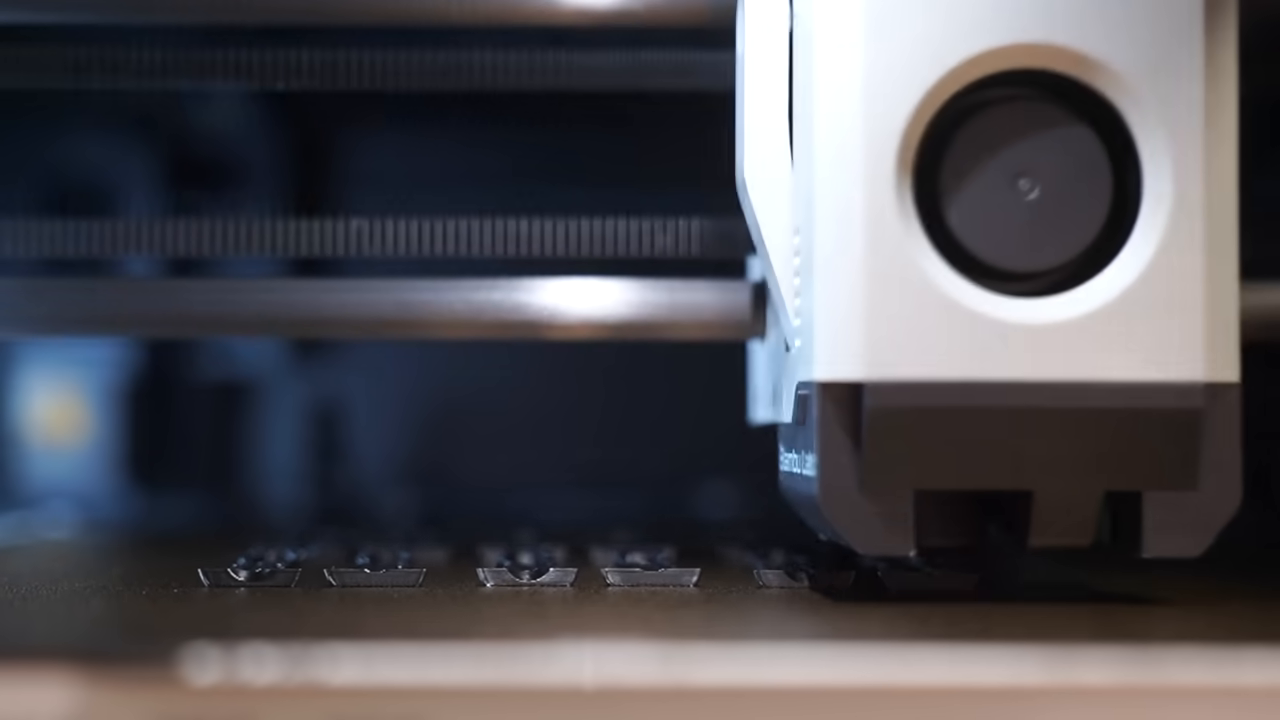
The final design added a flange... a small lip that sits flush against the wall surface and prevents the anchor from pushing through. He also added a countersink so the screw head sits flat.
![[02:12] A close-up showing the failed second iteration of the anchor shattering inside the wall.](/wp-content/uploads/video-articles/20260329-200615/key_02m12s.png)
The result? A custom drywall anchor that performs beautifully. Four cents in PLA filament. Twelve minutes of print time. Design files shared for free.
Four cents. Twelve minutes. Five failures.
Why This Matters Beyond Drywall
I want you to think about those five iterations for a second.
![[03:20] A clear cutaway view of the final anchor design successfully buckling and clamping behind the drywall.](/wp-content/uploads/video-articles/20260329-200615/key_03m20s.png)
Because this isn't really about drywall anchors. It's about the rapid prototyping loop that changes how problems get solved. Fail. Analyze. Constrain. Redesign. Test again.
Every broken prototype gave Steven specific, actionable information. The spinning told him he needed spurs. The shattering told him the geometry was too thin. The pop-through told him he needed a flange. Each failure was a teacher... not an obstacle.
Consumer 3D printing has reached a point where a $299 printer can produce functional parts at pennies per unit. That's not a novelty anymore. That's a fundamental shift in who gets to be an engineer. The barrier between "I have an idea" and "I'm holding the thing" has never been thinner.
And when Steven uploads those design files to his website for free? Now his five failures become everyone's starting point. That's the open-source design multiplier. One person's iteration becomes a community's foundation.
The Whiteboard Principle
Here's what I keep coming back to.
![[03:57] On-screen detailing the final breakdown of the project, including a material cost of $0.04 and a 12-minute print time.](/wp-content/uploads/video-articles/20260329-200615/key_03m57s.png)
The printer didn't solve the problem. The whiteboard did.
Three constraints. Written clearly. Checked off methodically. That's the framework that turned random tinkering into structured problem-solving. The printer just made the feedback loop fast enough to be useful.
You don't need a 3D printer to apply this. You need a whiteboard. Or a notebook. Or a sticky note on your monitor.
What must be true for this to work?
Write it down. Build toward it. Let the failures teach you. And when something shatters... good. Now you know what to make stronger.
Time × Focus = Attention. Steven gave twelve minutes per print and full focus to each failure. That's how four cents of plastic becomes a lesson in engineering thinking.
The maker culture movement keeps proving something I believe deeply... the people closest to the problem are often the best equipped to solve it. They just need permission to break things along the way.
Five iterations. Four cents. One principle that bridges drywall anchors and everything else worth building... define your constraints, embrace the shatter, and let every failure sharpen the next attempt. The files are free. The lesson is priceless. Now... what's your whiteboard moment? 💪
Original video by Practical Prints — Watch on YouTube ↗
Get the Ultimate Gemstone Look with These AdvancedA professional VFX lighting lead’s free crystal tutorial reveals deep parallels between procedural damage in 3D modelingGenerosity, Craft MasteryDitch Expensive SEO Tools: Automate AI SEO KeywordAn n8n workflow using DataForSEO’s pay-as-you-go API delivers comprehensive keyword research (200 keywords with volume, Craft Mastery, Resourcefulness
Echoes
Wisdom from across the constellation that resonates with this article.
“Consider how a sub-$300 3D printer could replace store runs for small functional parts”
— Practical Prints | 3D Printing is INSANELY practical. Same Expert
“Apply the whiteboard constraint method to current design or problem-solving challenges”
— Practical Prints | 3D Printing is INSANELY practical. Same Expert
“Explore free drywall anchor STL files at 3dprinteracademy.com”
— Practical Prints | 3D Printing is INSANELY practical. Same Expert