
A YouTube rabbit hole. A 100-year-old mechanism. A room full of 3D printers. Sometimes the best projects find you... you just have to say yes.
Michael Laws saw a video. Hand Tool Rescue restored a fractal vise from the early 1900s... a jaw mechanism that morphs to grip virtually any shape. Irregular objects. Organic curves. Things no flat-jawed clamp could ever hold.
He watched it grip a wrench, conform around it like fingers, and hold tight.
His response? "I need one."
You can't buy these. They don't exist on shelves. So he did what makers do... he built his own. From scratch. Designed in Onshape, printed on an FDM printer, and shared with the world as open-source hardware.
The Fractal Principle
Here's where it gets beautifully nerdy.

Fractal geometry is the idea that patterns repeat at smaller and smaller scales. Think of broccoli... the overall shape echoed in each tiny floret. Or the Mandelbrot set, where zooming in reveals infinite self-similarity. It's the universe rhyming with itself.
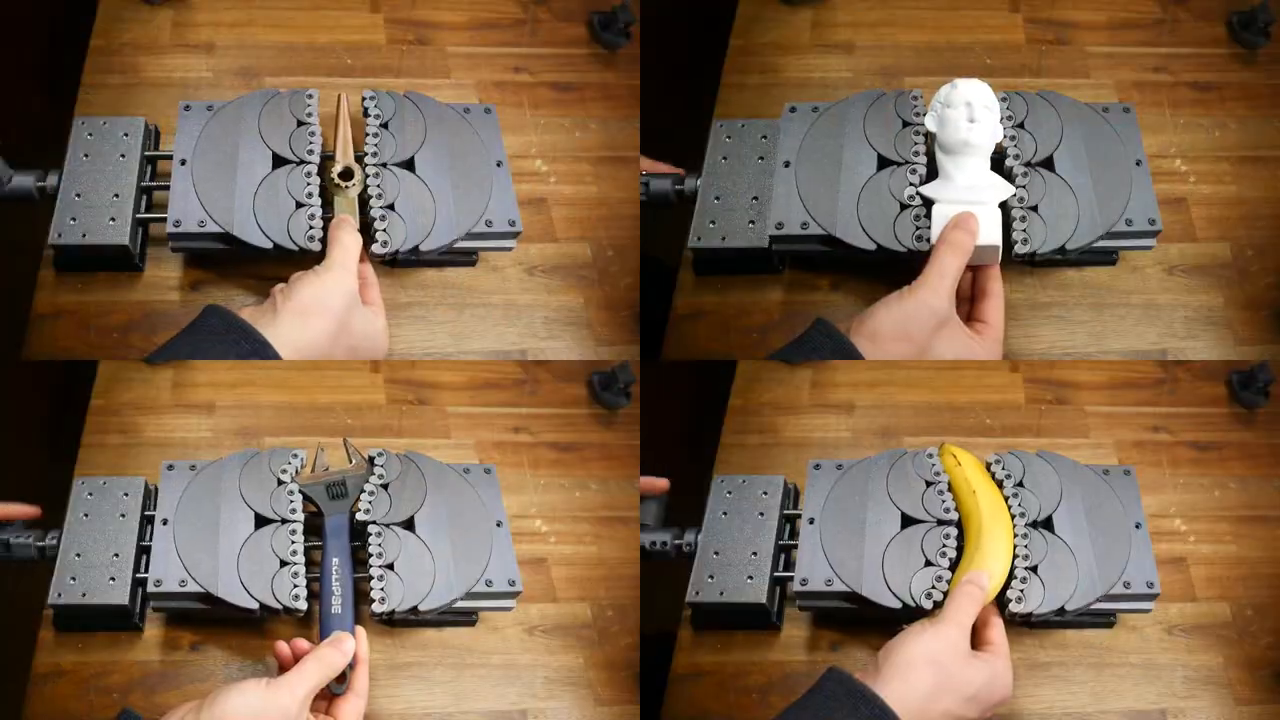
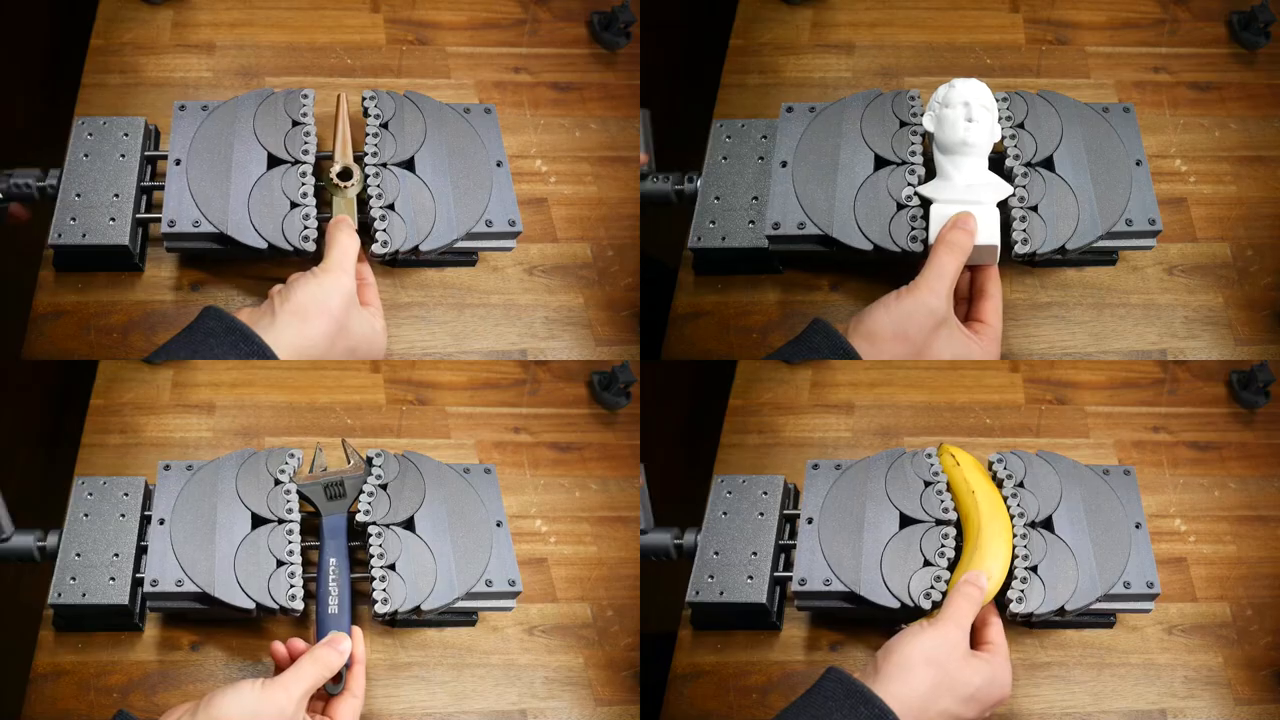
The vise applies this principle mechanically. The largest arc holds two arcs at half its diameter. Each of those holds two more. And again. Each level doubles the number of contact points conforming to whatever you're gripping. A banana. A bust. A kazoo. The geometry doesn't care about the shape... it just wraps around it.
Self-similar geometry at decreasing scales translating into mechanical advantage. That's not just clever engineering. That's elegance.
Designing for Reality
Here's where the real craft lives. Having a beautiful concept means nothing if you can't actually build it.
Laws set himself hard constraints from the start:
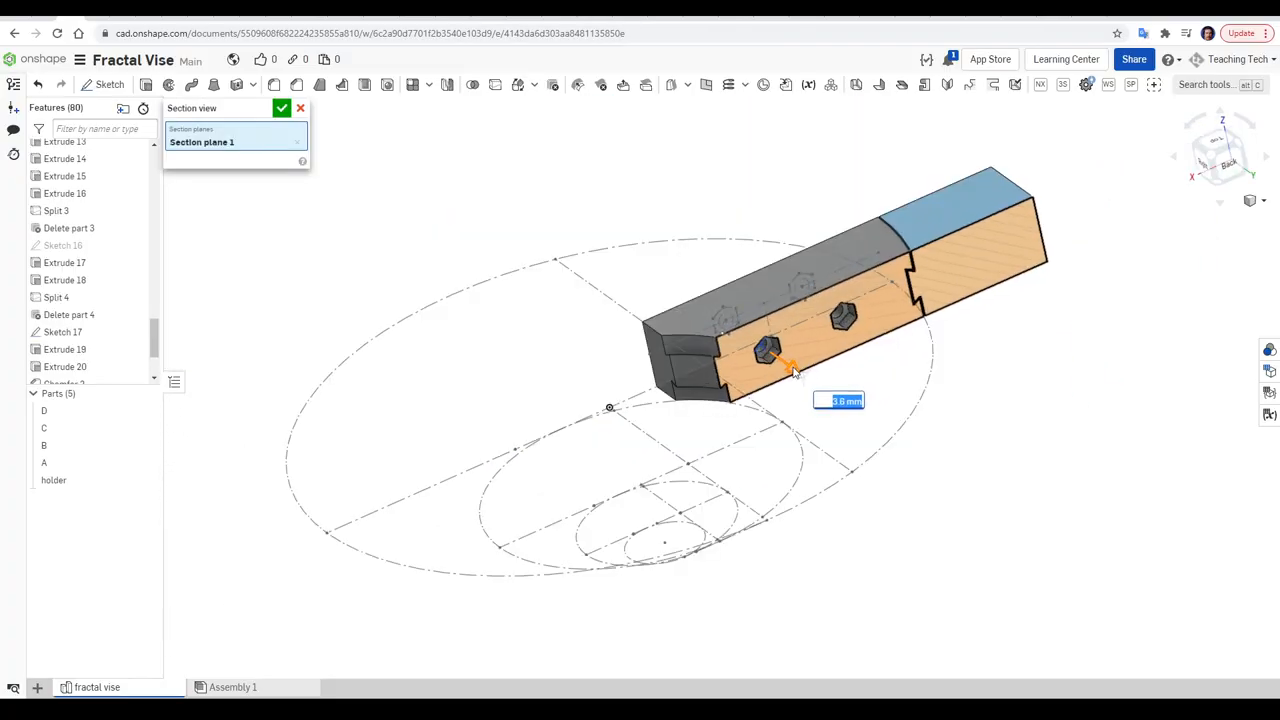
- No support material. The double dovetail joint mechanism means there's always a tricky overhang. His solution? Split each segment in half horizontally. Flat on the bed. Crisp dovetails. Zero supports. This technique alone is worth studying for anyone wrestling with complex 3D printing assemblies.
- Fully constrained parts. Early Thingiverse designs let pieces rotate freely... too freely. Wiggle them wrong and the whole thing disassembles itself. Instead of adding grub screws, Laws built geometric stoppers directly into the parts. Rounded sections that naturally contact the parent piece and limit rotation. No extra hardware. No extra complexity. Just thoughtful geometry.
- Parametric everything. The entire design is driven by parametric modeling variables in Onshape. Change one value and the whole vise scales. This isn't just convenient... it's what makes true open-source collaboration possible. Someone else can take the design, edit a few numbers, and make it their own.
- Minimal plastic. A solid body works at small scales. At full vise size? That's wasteful. Only the essential mechanical pieces are printed.
Each constraint forced a creative solution. And each solution made the design better, not worse.
The Tolerance Lesson
One detail stuck with me.
First version? Tolerances too loose. Parts moved but fell apart. Laws didn't just tighten the gap uniformly... he changed the formula so clearance was halved on the top and bottom of the dovetail while maintaining full movement range. A subtle, intentional adjustment.
Then there's elephant's foot and warping on base layers. Printing overnight in winter introduced just enough inaccuracy to ruin the mechanism. His advice is simple and honest: print small test pieces first. Verify the fit before committing to a full parts run.
This is the unsexy part of making. The part nobody posts about. Reprinting. Adjusting. Running your parts back and forth until plastic wears away high spots. Putting grease between mating surfaces. Testing. Again.
The fractal vise is flashy when it works. Getting it to work is quiet, methodical patience.
Assembly as Craft
The build itself follows a satisfying logic... big to small. Trapped M3 nuts pressed in with bolts. Dovetail halves slid into parent holders. Small filament pieces used as alignment pins. Each sub-assembly tested for free movement before proceeding.
Laws even designed false surfaces... thin printed layers that seal holes needed for support-free printing. You drill through them during assembly. It's a small detail that reveals how deeply he thought about the relationship between design for manufacturing and the person actually building the thing.
TPU feet. Lead screw collars to eliminate play. A folding handle that extends for speed or tucks to 90 degrees for torque.
Every choice serves the person holding the tool.
Open Source as Legacy
The STLs are on Thingiverse. The STEP file of the complete assembly is uploaded. The source CAD is linked in Onshape so anyone can fork, modify, and improve it.
This is what open source actually looks like. Not just sharing files... sharing the thinking. The variables. The parametric relationships. The ability for someone to take your work and make it genuinely theirs.
Laws acknowledges other designers working on the same problem... Borge, Cleric, agmcml... each with different approaches worth exploring. No gatekeeping. No competition. Just a community of makers riffing on a century-old idea, each adding their own layer.
The original vise was forged in metal by hands we'll never know. A hundred years later, it's being reborn in PLA by hands all over the world.
That's not just making. That's the fractal at work... the same creative impulse repeating at every scale, in every era.
Here's what gets me. This whole project started because an algorithm surfaced a random video. One person watched it, got obsessed, and chose to build rather than wish. Then chose to share rather than hoard. The fractal vise grips irregular shapes by meeting them where they are... conforming instead of forcing. There might be a lesson in that beyond the workshop. Build something. Share the source files. Let someone else zoom in and find their own pattern. 🛠️✨
Original video by Teaching Tech — Watch on YouTube ↗
Echoes
Wisdom from across the constellation that resonates with this article.
“Design like a pro with shadow lines – 3D design for 3D printing – Check out my 2nd channel, TT Racing: https://www.youtube.com/@ttracingYT To get the best out of 3D printing, it helps if you can desi”
— Teaching Tech | Design like a pro with shadow lines – 3D design for 3D printing Same Expert
“3D printed fractal vise – The coolest tool you didn’t know you needed – I saw an awesome video by Hand Tool Rescue of a 100+ year old fractal vise being restored and just had to have one. CAD and 3D p”
— Teaching Tech | 3D printed fractal vise – The coolest tool you didn’t know you needed Same Expert
“Make your parts bendy with this design hack – 3D design for 3D printing – Check out my 2nd channel, TT Racing: https://www.youtube.com/@ttracingYT To get the best out of 3D printing, it helps if you “
— Teaching Tech | Make your parts bendy with this design hack – 3D design for 3D printing Same Expert