

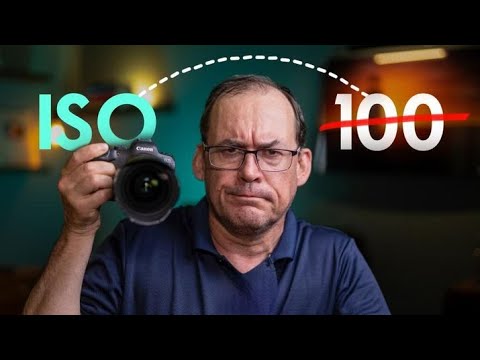
You've been lied to. Not maliciously. More like that well-meaning uncle who swears the engine will explode if you ever let the RPMs climb past 3,000. The photography world has a version of this... and it's the rigid commandment to never raise your ISO above 100.
Simon d'Entremont, a professional wildlife photographer out of eastern Canada, just dropped a video that dismantles one of the most persistent myths in photography. And the way he breaks it down? Clean. No fluff. Just truth with receipts.
Here's the core of it.
ISO is not a light source. It's a gain knob. A volume dial. It doesn't create noise... it reveals the noise that was already there because you didn't feed your sensor enough light. The technical term is signal-to-noise ratio. Poor light equals poor signal. Poor signal equals noisy image. ISO just turns up the volume on whatever's already happening.
Simon proved it with a side-by-side demonstration that should be required viewing for every photographer clutching their ISO 100 security blanket. He shot an owl figurine at ISO 12,800 with proper exposure, then shot the same scene at ISO 1600 but deliberately underexposed it. When he brightened the underexposed shot in post... it was noisier. The lower ISO image looked worse.
Let that land.
The photo shot at eight times the ISO was cleaner. Because it had more light. Because the sensor had actual signal to work with instead of scraping the bottom of a dark barrel.
The Real Cost of Playing It Safe
This isn't just a nerdy technical debate. This fear of ISO is actively destroying photographs. Simon sees it constantly on photography forums... people asking why their images are blurry, why their wildlife shots are soft, why their handheld photos look like they were taken during an earthquake. The answer is almost always the same. They kept their ISO artificially low, which forced their shutter speed down to compensate, and the result was motion blur or camera shake.

![[02:27] A split-screen showing an owl figurine shot at ISO 12,800 next to a significantly darker, underexposed version shot at ISO 1600.](/wp-content/uploads/video-articles/20260328-023316/key_02m27s.png)
![[02:40] A split-screen close-up of the same owl figurines after the ISO 1600 image's exposure was raised in post-processing, revealing it is significantly noisier than the ISO 12,800 image.](/wp-content/uploads/video-articles/20260328-023316/key_02m40s.png)
Think about it like this. You can have a noisy photo that captured the moment... or a perfectly noise-free blur that captured nothing. Which one hangs on the wall?
Simon rattled off scenario after scenario where the "ISO 100 or bust" mentality falls apart:
- Freezing motion in landscapes. Waterfalls create wind. Leaves move. Waves crash. You need shutter speed to freeze those elements, and that means ISO has to climb.
- Shooting handheld. Indoors, in shade, early morning, late evening... anywhere the light isn't generous, you need ISO headroom to keep your shutter speed high enough for sharp images.
- Wildlife photography. Fast subjects in low light. That's the whole game. Simon shared an owl-in-flight shot at ISO 12,800. Noisy? A little. But it existed. The alternative was no photo at all.
He even showed a collection of stunning images all shot at ISO 8,000 and above. Not despite the high ISO... because of it. The high ISO made those images possible.
The Shift That Changes Everything
Here's where it gets practical. Simon's preferred shooting method is Manual mode with Auto ISO. He sets his shutter speed to freeze the action. He sets his aperture for the depth of field he wants. Then he lets the camera figure out the ISO.
ISO 200? Fine. ISO 3,200? Fine. ISO 6,400? Still fine.
Because here's the thing Simon makes crystal clear... shutter speed and aperture are artistic decisions. They shape how your image looks and feels. ISO? It's just a brightness adjustment. There's no artistic expression in choosing ISO 400 over ISO 800. Let the camera handle the math while you handle the art.
And if Auto ISO climbs too high? That's not the camera failing. That's the light telling you something. Lower the shutter speed if you can. Open the aperture. Add a flash or LED panel. The camera is doing exactly what it should... balancing the exposure triangle with whatever light you've given it.
Three Rules for Cleaner High-ISO Images
Simon dropped three practical tips that are worth memorizing:
![[08:32] Adobe Lightroom user interface showing a crop overlay on a photo of a duck, illustrating the advice to avoid heavy cropping on high ISO images.](/wp-content/uploads/video-articles/20260328-023316/key_08m32s.png)
1. Fill the frame. Cropping into a high-ISO image magnifies the noise. Get your composition right in-camera.
2. Use noise reduction software. Tools like Topaz Photo AI and others have gotten remarkably good at scrubbing noise while preserving detail. The technology has outpaced the fear.
3. Never underexpose to keep ISO low. This is the cardinal sin. For most cameras, shooting dark and brightening later produces worse results than just letting the ISO rise to properly expose the shot.
That last one is worth repeating. The instinct to keep ISO low by underexposing is doing the exact opposite of what you think it's doing. You're not preserving quality. You're destroying it.
Modern Cameras Are Better Than Your Fear
Simon pointed out that even crop sensor and Micro Four Thirds cameras... the smaller sensor formats that photographers sometimes dismiss... produce very usable images at ISO 1,600 to 3,200. Full frame sensors push well beyond that. He shared a short-eared owl photo taken on a Canon 7D Mark II from 2014 at ISO 6,400. A nine-year-old crop sensor camera. And it looked great.
![[09:55] A close-up demonstration of a Canon camera's LCD screen, showing the user navigating the menu to set the camera to Manual mode with Auto ISO.](/wp-content/uploads/video-articles/20260328-023316/key_09m55s.png)
The cameras have been ready. The software has been ready. The only thing holding most photographers back is a rule someone taught them that was never as absolute as it sounded.
Light doesn't fight darkness... it just shows up. Same principle applies here. Stop fighting your camera's ISO dial and start showing up for the shot. The noise you're so afraid of? It's just evidence that you were there, in the low light, chasing the moment. And that moment... properly exposed, a little grainy, full of life... will always beat the perfectly silent frame that never existed. 💪
Go raise your ISO on your very next outing. I know you can do it.
Original video by Simon d'Entremont — Watch on YouTube ↗
I Made the Same Game in 8 EnginesBuilding the same catch game across eight game engines reveals that core game logic is universal and the best engine is Realm-Recreation, Realm-WorkWhy video game doors are so hard to get rightVideo game doors are a microcosm of how the hardest, most invisible work requires massive cross-team coordination and a Realm-Recreation, Realm-Work
Echoes
Wisdom from across the constellation that resonates with this article.
“The TRUTH about shooting at ISO 100 that the PROS know. – Use code SIMON10 to get 10% off when you get my new Haukland Signature Edition Jacket, my 7-in-1 Parka Pro! https://haukland.de/products/haukl”
— Simon d’Entremont | The TRUTH about shooting at ISO 100 that the PROS know. Same Expert