


A physicist sees an arrow. A programmer sees a list. A mathematician sees pure abstraction. They're all staring at the same thing... and they're all right.
That's the opening move of 3Blue1Brown's first chapter in the Essence of Linear Algebra series. And honestly? It's less a math lesson and more a masterclass in perspective.
The Three Perspectives
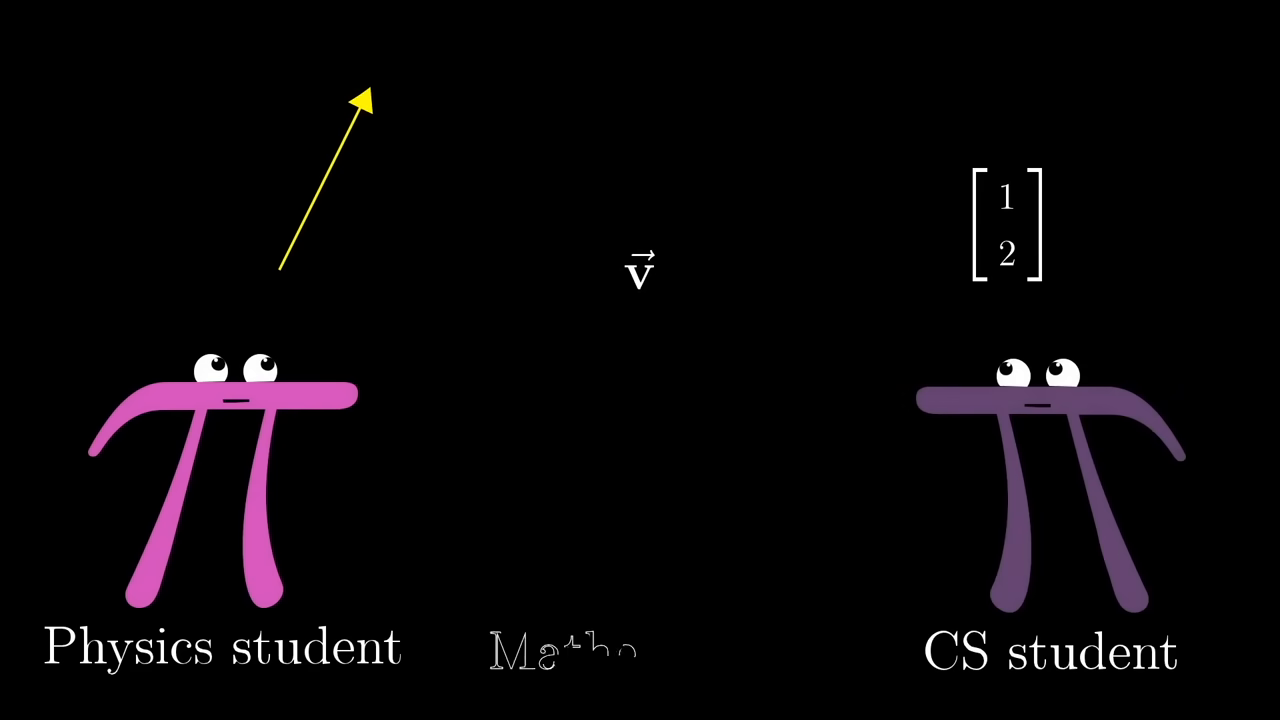
Grant Sanderson lays it out clean. Three students walk into a room:

![A house icon alongside a 2D vector [2600, 300000] illustrating the Computer Science perspective of vectors as lists of features.](/wp-content/uploads/video-articles/20260329-052126/key_01m06s.png)
- The physics student sees vectors as arrows... length and direction, floating free in space.
- The computer science student sees ordered lists of numbers. Square footage and price. Data with structure.
- The mathematician steps back further. A vector is anything you can add together and scale. That's it. No shape required.
None of them is wrong. All of them are incomplete alone.
Sounds a lot like life, doesn't it?
Rooted at the Origin
Here's a detail that stopped me. In physics, vectors can live anywhere... free-floating arrows drifting through space. But in linear algebra, vectors are almost always rooted at the origin. Tail pinned to the center. Every measurement, every movement, starts from a fixed point.
There's something grounding about that. Before you can move in any direction, you need to know where you're standing. The coordinate system isn't a cage. It's a home base. A place to measure from.
The video walks through this carefully... horizontal x-axis, vertical y-axis, the origin as "the center of space and the root of all vectors." Then coordinates become instructions. Walk 3 to the right. Walk 2 up. Every pair of numbers maps to exactly one arrow, and every arrow maps to exactly one pair.
One-to-one. No ambiguity. That kind of clarity is rare... and worth chasing.
Addition: Tip to Tail
Vector addition is where it gets beautiful.
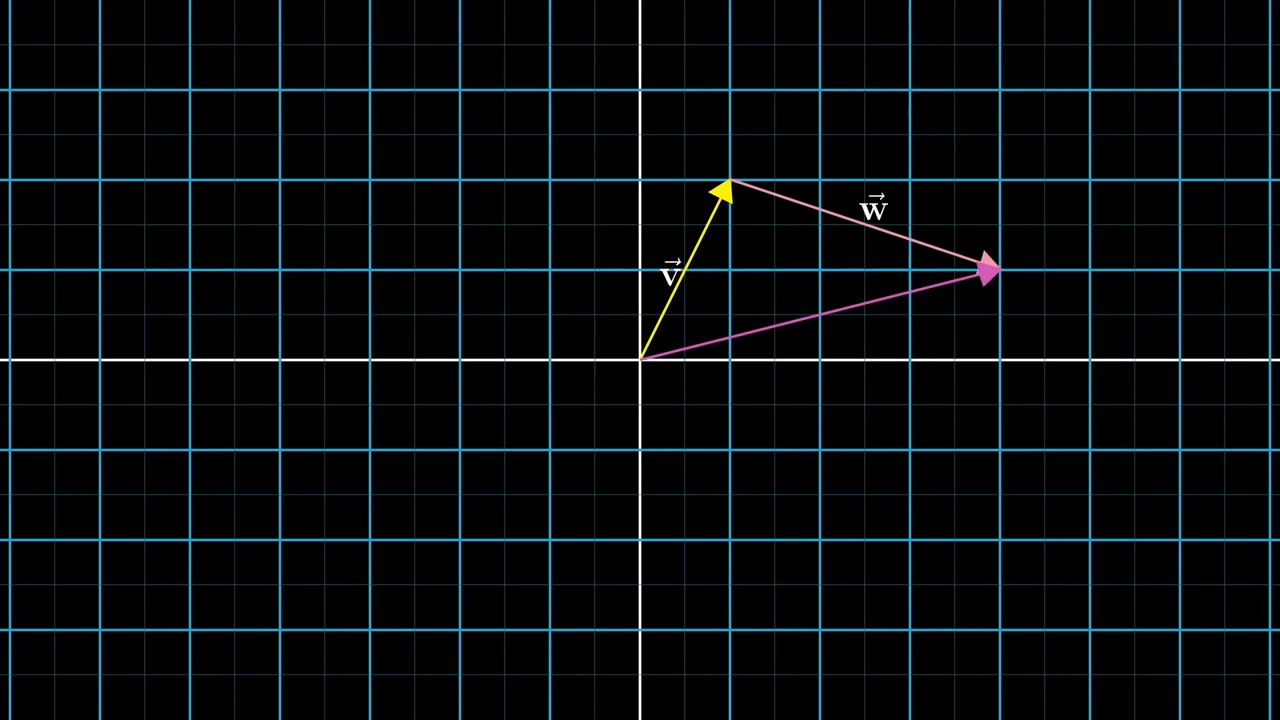
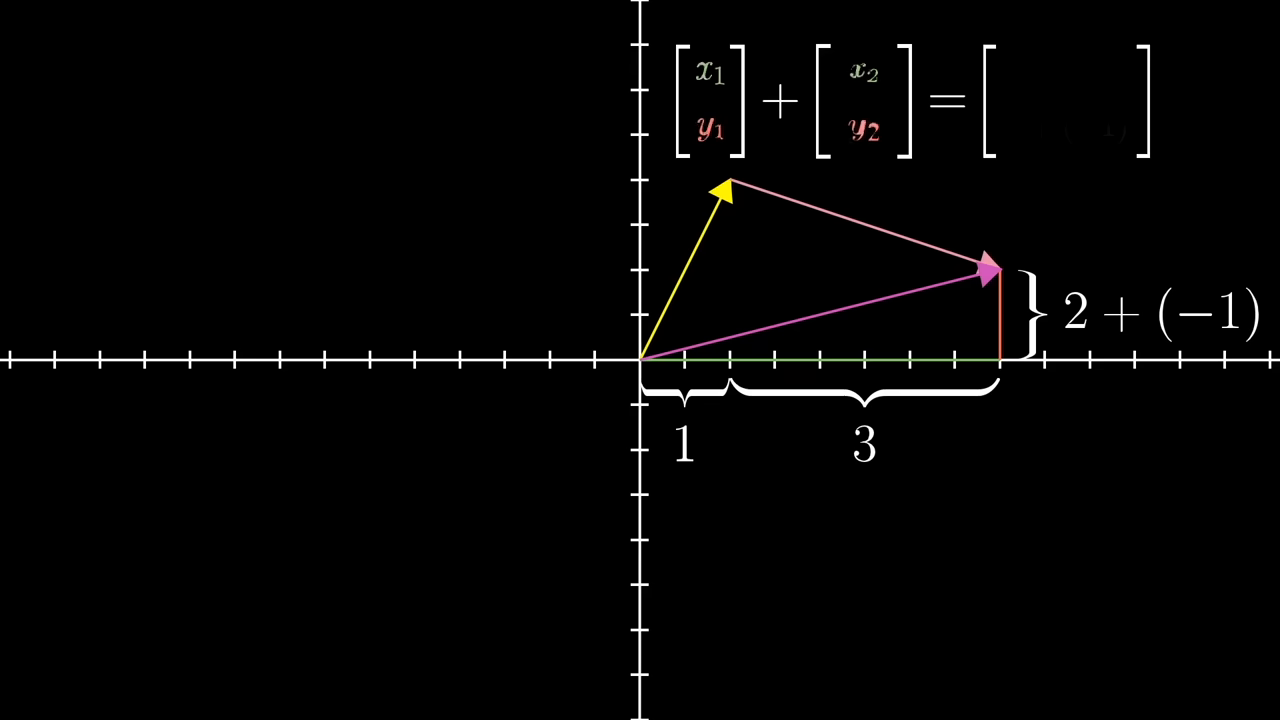
Geometrically, you take the second arrow and place its tail at the tip of the first. Draw a new arrow from start to finish. That's your sum.
Numerically? Just match up the components and add. [1, 2] + [3, -1] = [4, 1].
Two completely different ways of describing the same truth. One visual, one computational. And the magic isn't in either approach alone... it's in the translation between them.
Sanderson connects it back to something we already know: adding on a number line. Two steps right, then five more. Same as seven. Vector addition is that same intuition, just grown up and given a second dimension to play in.
Scaling: Stretching What Already Exists
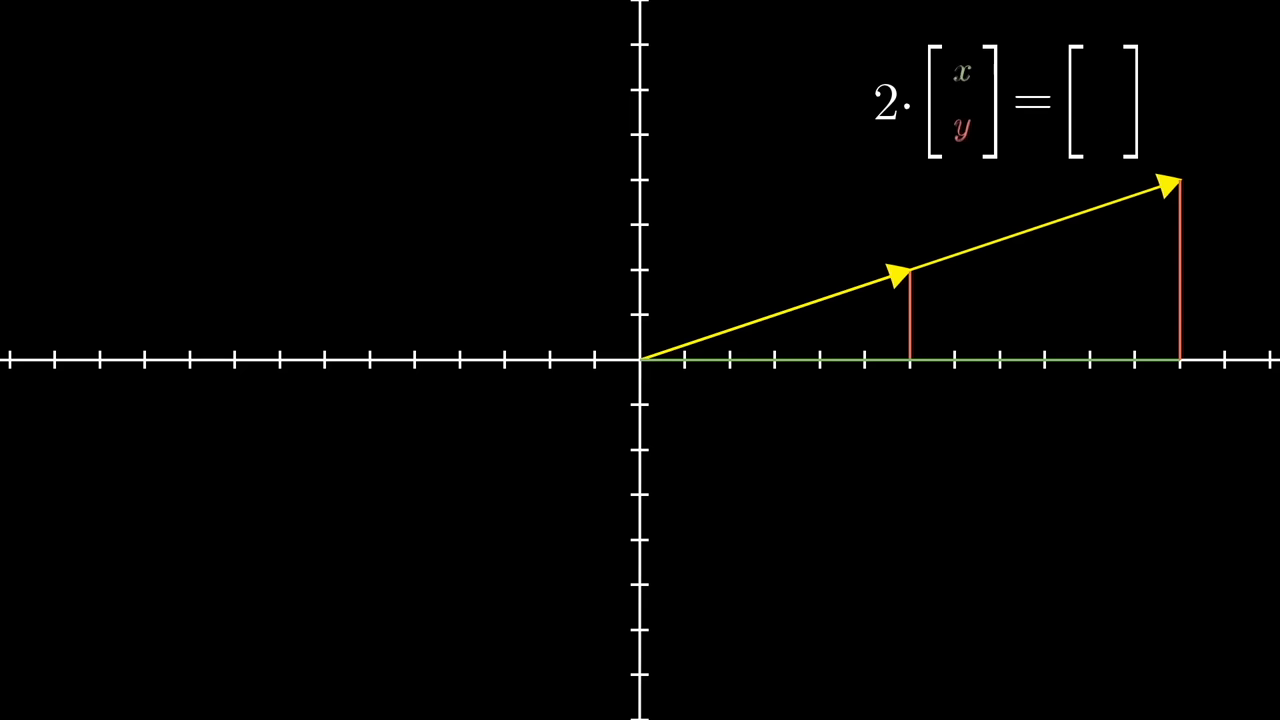
The second fundamental operation is scalar multiplication. Multiply a vector by 2, it doubles in length. Multiply by 1/3, it shrinks. Multiply by a negative number and it flips direction, then stretches.
This is why numbers in linear algebra are called "scalars." Not because they're somehow lesser... but because their job is to scale. To stretch or compress what's already there.
That etymology matters. The word "scalar" doesn't come from abstract notation. It comes from the physical act of scaling... making something bigger or smaller without changing its essential direction. The name describes the verb. The math serves the meaning.
Numerically, scaling just means multiplying every component by the same factor. Clean. Predictable. But the geometric picture gives it weight... you can see the arrow stretch and contract.
The Real Power: Translation
Here's where Sanderson lands the plane, and it's the insight worth sitting with:
> "The usefulness of linear algebra has less to do with either one of these views than it does with the ability to translate back and forth between them."
Data analysts get to see their spreadsheets as shapes in space. Physicists get to crunch their spatial intuitions into numbers a computer can swallow. Animators think in motion, then convert to pixels.
This back-and-forth... geometric to numeric, numeric to geometric... is the actual superpower of linear algebra. Not the arrows. Not the lists. The bridge.
And that's a principle that echoes way beyond math.
When we can see something from only one angle, we think we understand it. When we can translate fluidly between perspectives... feel the geometry and run the numbers... that's when understanding deepens into something useful.
Why This Matters Beyond the Textbook
This video is ostensibly about vectors. Chapter 1. The basics.
But underneath the coordinates and arrows, it's really about how to see. How different lenses reveal different truths about the same reality. How no single representation captures the whole picture. How the real skill isn't mastering one view... it's learning to move between them.
Linear algebra shows up everywhere: machine learning, computer graphics, data science, quantum mechanics, signal processing. It's the hidden grammar behind tools we use every day. And it all starts here... with an arrow, a list of numbers, and the willingness to see both as the same thing.
Three perspectives. Two operations. One building block.
Simple enough to explain in ten minutes. Deep enough to power an entire field.
So the next time you're stuck... on a problem, a decision, a conversation that isn't landing... ask yourself: am I seeing the arrow, or the numbers? The shape, or the data? Sometimes the breakthrough isn't a new answer. It's the same answer, seen from a different angle. That's where the real algebra of life happens. ✨
Original video by 3Blue1Brown — Watch on YouTube ↗
3D Gaussian Splatting: 10 Reality-Bending TricksGaussian Splatting is democratizing photorealistic 3D capture of reality across eight powerful use cases spanning memoryRealm-Mind, Realm-WorkGet the Ultimate Gemstone Look with These AdvancedA professional VFX lighting lead’s free crystal tutorial reveals deep parallels between procedural damage in 3D modelingRealm-Mind, Realm-WorkHow Filmmakers Make Cameras Disappear | Mirrors inFour distinct filmmaking techniques for hiding cameras in mirror shots reveal a deeper truth about the craft of doing esRealm-Mind, Realm-Work
Echoes
Wisdom from across the constellation that resonates with this article.
“Apply the independence/redundancy framework beyond math: audit teams, projects, or life areas for linearly dependent contributions”
— 3Blue1Brown | Linear combinations, span, and basis vectors | Chapter 2, Essence of linear algebra Same Expert
“Visualize collections of vectors as point clouds (tips only) rather than cluttered arrow fields to build intuition for span”
— 3Blue1Brown | Linear combinations, span, and basis vectors | Chapter 2, Essence of linear algebra Same Expert
“Practice reinterpreting familiar (x,y) coordinates as scalar multipliers of basis vectors rather than static positions”
— 3Blue1Brown | Linear combinations, span, and basis vectors | Chapter 2, Essence of linear algebra Same Expert