


We spent 20 years tracking whales, logged over 100 dives, engineered silent cameras with invisible red light... and got a few minutes of footage of a giant squid. A few minutes. Then someone dipped a syringe into the water and found an entire hidden world.
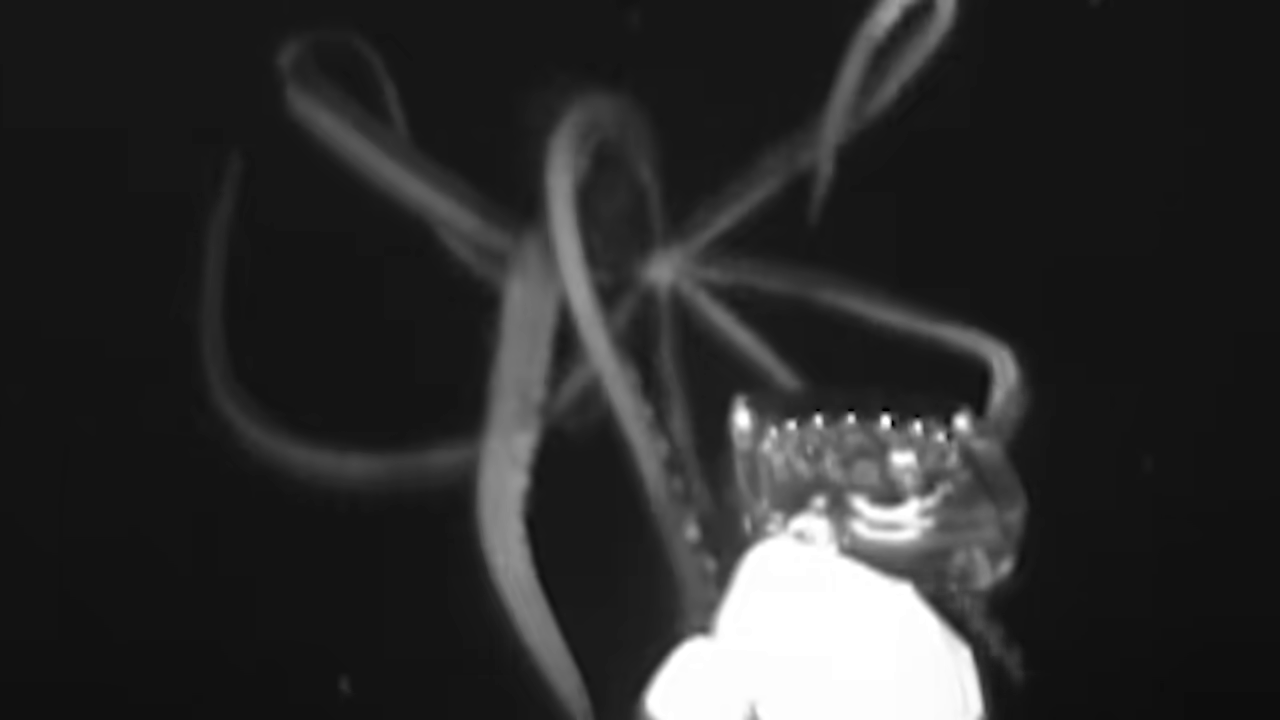
There's a creature in the deep ocean called the colossal squid. We know it exists because sperm whales eat tons of them. Literally. Something like 80% of a sperm whale's diet. So there must be massive populations down there.
And yet... we didn't film a live one in its natural habitat until 2025. A hundred years after we first knew it was real.
Let that sink in.
We've mapped the surface of Mars with more detail than we've mapped our own ocean floor. The deepest parts of the sea... the abyssal zone, the hadal zone... are pitch black, crushing, and hostile to every tool we've built to explore them. You send a robot down with lights and motors, and the animals adapted to dark silence just vanish. You drag a net, and soft-bodied creatures disintegrate on the way up.
The ocean isn't hiding from us. We just keep showing up with the wrong flashlight.
The Biggest Migration You've Never Heard Of
During World War II, sailors noticed something terrifying on their sonar. A shadow that looked like the seafloor... except it was rising. Every night, this phantom layer crept hundreds of meters toward the surface. Every morning, it sank back down.

![[00:11] A pie graphic overlaid on an animation of a colossal squid and sperm whale, indicating the squid makes up ~80% of the whale's diet.](/wp-content/uploads/video-articles/20260330-002557/key_00m11s.png)
![[00:48] A size graphic showing a 9.8m Colossal Squid scaled next to a 1.76m human.](/wp-content/uploads/video-articles/20260330-002557/key_00m48s.png)
![[02:01] A pixel-art style "Choose Your Player" menu showing four underwater exploration methods: Diver, AUV, ROV, and Sub.](/wp-content/uploads/video-articles/20260330-002557/key_02m01s.png)
It wasn't the seafloor. It wasn't an enemy fleet.
It was the diel vertical migration. Billions of tons of animals rising from the deep to feed at the surface every single night. More biomass moving than the Great Migration across Africa. Happening every night. Right now. Beneath every ocean on Earth.
And here's where it gets beautifully connected... those creatures eat phytoplankton that pull carbon dioxide out of our atmosphere, then carry that carbon deep into the sea as waste. This migration is literally sequestering carbon from our air. The ocean's been fighting climate change longer than we've known climate change was a fight.
But we still can't tell you exactly who is migrating, when, or why different species rise at different times. Sound waves tell us something is down there. Just not what.
Enter the Drop of Water
Every living thing sheds. Scales. Mucus. Tissue. Waste. Little genetic breadcrumbs drifting through the water column like cosmic dust. Scientists call it environmental DNA... eDNA.
![[04:45] An animated cross-section of the ocean showing arrows labeled "CARBON" moving downwards from surface phytoplankton, illustrating the carbon cycle.](/wp-content/uploads/video-articles/20260330-002557/key_04m45s.png)
The concept is almost absurdly simple. Dip a syringe into the ocean. Filter the water. Extract the DNA. And suddenly you can detect the presence of species without ever laying eyes on them.
Think about that for a second. No submersible. No 20-year research program. No hundred dives. A drop of water.
Researchers used this to find angel sharks... critically endangered ambush predators so good at hiding that for years, the only sightings were accidental catches by fishermen. Scientists had nearly declared them extinct in certain areas. Then they sampled the water, found spikes in angel shark DNA, sent divers to those exact spots... and there they were. Alive. Present. Just invisible to every method we'd tried before.
90% Unknown
Here's the part that genuinely shook me.
![[07:40] An on-screen bulleted list titled "WHY SO BIG?" with points "1. EFFICIENCY", "2. ISOLATION", and "3. COLD" appearing sequentially.](/wp-content/uploads/video-articles/20260330-002557/key_07m40s.png)
When researchers collected eDNA samples from the abyssal plain... the vast, seemingly desolate mud flats of the deep ocean floor... 90% of the DNA they recovered didn't match anything in any database on Earth.
Ninety percent.
Scientists call this dark taxa. Not dark because it's sinister. Dark because it's unknown. Unclassified. Unnamed. Never seen, never caught, never described by science.
We thought the abyss was a desert. Turns out it might be one of the most biodiverse places on the planet... we just couldn't see it because we were looking with our eyes instead of listening with the water.
Receipts for the Future
What makes eDNA even more remarkable is that samples can be preserved and re-analyzed years later as genomic databases grow and AI and machine learning improve. Today's water sample is tomorrow's discovery. You don't need to know what you're looking for right now. You just need to collect.
Teams in Antarctica are sampling for colossal squid DNA as we speak. Not hoping to get lucky with a camera in the dark... but building heat maps of where these animals actually live, based on the genetic trails they leave behind.
Imagine a future where we don't need a century of luck to find a species. Where a single expedition with water samplers tells us more about deep-sea biodiversity than decades of crewed submersible dives.
That future isn't imaginary. It's happening.
Why This Matters Beyond the Ocean
I keep coming back to the metaphor. We spent generations pointing bigger and brighter lights into the darkness, scaring away the very things we wanted to see. Then someone asked a different question... not "How do we look harder?" but "What did they leave behind?"
That shift... from chasing to listening, from forcing to receiving... that's not just marine science. That's a life principle.
Sometimes the evidence of what's real, what's alive, what matters... it's already in the water around you. You just need a different way to notice it.
The ocean has been quietly working this whole time. Migrating carbon into the deep. Harboring species we haven't earned the right to name yet. Running the largest ecosystem on the planet without a single spotlight.
Light doesn't fight darkness. It just shows up. And sometimes... it shows up as a drop of water.
90% unknown. Not 90% empty... 90% undiscovered. The abyss isn't a wasteland. It's a library we haven't learned to read yet. And the tool that cracks it open isn't a billion-dollar submersible. It's patience, curiosity, and a syringe of seawater. The biggest things hiding in our world don't always require the biggest search parties. Sometimes they just need someone willing to look differently. 💙
Original video by Cleo Abram — Watch on YouTube ↗
Get the Ultimate Gemstone Look with These AdvancedA professional VFX lighting lead’s free crystal tutorial reveals deep parallels between procedural damage in 3D modelingPatienceDitch Expensive SEO Tools: Automate AI SEO KeywordAn n8n workflow using DataForSEO’s pay-as-you-go API delivers comprehensive keyword research (200 keywords with volume, Curiosity
Echoes
Wisdom from across the constellation that resonates with this article.
“Consider connections between ‘dark taxa’ concept and unseen potential in underserved youth populations”
— Cleo Abram | What’s Really Hiding In The Deepest Oceans Same Expert
“Track New Zealand Antarctica eDNA colossal squid research for follow-up content”
— Cleo Abram | What’s Really Hiding In The Deepest Oceans Same Expert
“Explore eDNA as a metaphor for ‘listening vs. chasing’ in mentorship and youth work contexts”
— Cleo Abram | What’s Really Hiding In The Deepest Oceans Same Expert